
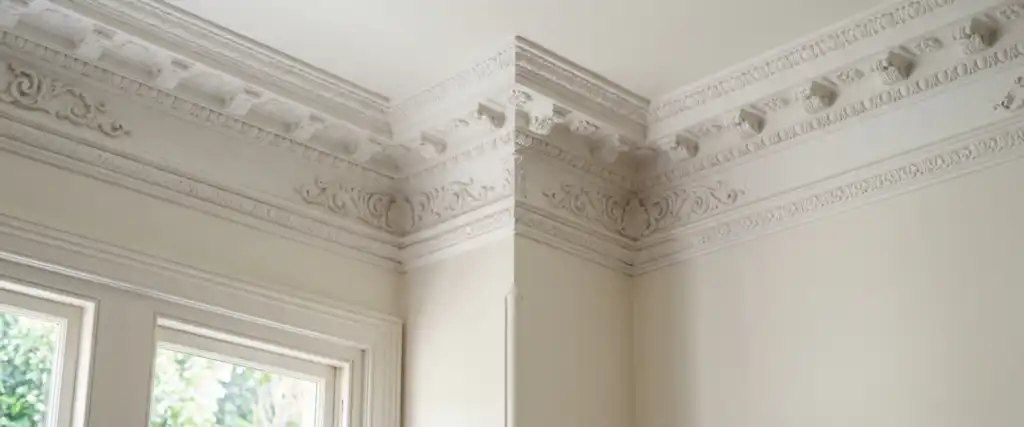
Choosing between a plain cornice and a fancy cornice comes down to the style of your home, not just personal taste — a heavily moulded, ornate profile suits a Federation or Victorian-era Sydney home, while a clean, square-set or minimal cornice line suits contemporary and coastal interiors. Get the match wrong and even a beautifully finished ceiling can look out of step with the rest of the house. This guide walks through how to read your home’s existing architecture, when a fancy cornice earns its place, and when a simpler line will actually look better and age better.
Key Takeaways
- Match the era: ornate, decorative cornices suit period homes; plain or square-set lines suit modern builds.
- Room proportions matter: deep, heavily detailed cornices can overwhelm low ceilings or small rooms.
- Consistency counts: mixing cornice styles between adjoining rooms usually looks unplanned rather than eclectic.
- Maintenance differs: more detailed profiles collect more dust and need more careful repainting.
- Style decisions should come before installation, not after — reworking cornice profiles later means removing and refitting.
Plain Cornice or Fancy Cornice: What’s the Real Difference?
A plain cornice is a simple, low-profile strip that softens the joint between wall and ceiling without drawing attention to itself. It’s typically a shallow cove or a square-set line finished flush with a crisp shadow gap. A fancy cornice, by contrast, is a moulded profile with layered detail — dentil work, floral or leaf motifs, stepped returns, or a deep classical curve — designed to be noticed. At Empire Interior Plastering, we install both, from clean square-set lines through to decorative fancy cornices and ornate ceilings, and the choice genuinely changes the character of a room, not just its trim.
A plain cornice suits rooms where the ceiling shouldn’t compete with anything else — a bulkhead housing downlights, a home theatre fitout with a dark, feature-heavy ceiling, or an open-plan living space where the eye should travel to joinery and finishes instead. A fancy cornice works the opposite way: it’s the ceiling saying something about the room, which is exactly why it needs to suit the house it’s in.
When a Fancy Cornice Suits a Sydney Home
Sydney has a lot of housing stock where an ornate profile genuinely belongs — Federation cottages, Victorian terraces, and older Californian bungalows across the Macarthur and South-West Sydney area, including Picton, Campbelltown and Camden, often still carry their original decorative plaster detail, or did before a renovation stripped it out. In these homes, a fancy cornice isn’t decoration for its own sake — it’s restoring the proportions the house was designed with. High ceilings, deep skirtings and picture rails all expect a cornice with enough presence to hold its own against them. Westgyp’s guidance on modern Cornice Designs: Popular Ceiling Cornice Styles for Australian Homes sets this out in more detail.
A fancy cornice also earns its place in a formal living or dining room in an otherwise contemporary home, where the owner wants one space to feel more considered than the rest — provided the transition into adjoining rooms is handled deliberately rather than left to look like an unfinished job. Plaster cornice installation in these settings usually means matching an existing profile exactly, which takes more care than a straightforward new install because the old moulding has to be measured and reproduced rather than picked from a catalogue.
A cornice should look like it was always meant to be there — not like it was added afterwards.
Where a home has genuine period features worth continuing — deep architraves, ceiling roses, panelled doors — a fancy cornice reinforces that language. Where those features aren’t there, adding an ornate cornice on its own can look like a single mismatched flourish rather than a coherent style choice.
If you’re weighing up cornice style for an upcoming renovation or new build, the team at Empire Interior Plastering can take a look at your home and talk through what will actually suit it — call 0413 887 289 or get in touch for a free quote.
When a Plain Cornice Is the Better Call
Most new builds and recent renovations across Sydney are working with cleaner lines, larger glazing, and flatter, simpler ceiling planes — and a plain or square-set cornice suits that language far better than an ornate one. In a new home, a heavily detailed cornice can read as an add-on rather than part of the design, because nothing else in the room is asking for that level of detail. A square-set finish, where the wall runs straight into the ceiling with a fine shadow line instead of a moulded strip, has become a common choice in these builds precisely because it disappears rather than competes.
A plain cornice is also the more practical choice in rooms with lower ceiling heights, where a deep decorative profile can make the room feel more enclosed rather than more finished. It’s a detail worth raising early with your plasterer rather than deciding on-site, since cornice style interacts with ceiling height, downlight layout and any bulkhead work in the same room. If you’re already reviewing broader plasterboard choices for the project, our guide to plasterboard finish levels covers how the wall and ceiling finish underneath the cornice affects the final look too.
If your project involves a home theatre or a media room, a plain cornice or a fully cornice-less square-set ceiling is usually the right call — the ceiling there is doing acoustic and lighting work, and a decorative profile just adds visual clutter to a space designed to be looked past, not at.
Keeping Cornice Choices Consistent Through a Renovation
The most common mistake we see isn’t choosing the wrong cornice style — it’s choosing different styles in different rooms without a reason for the change. A fancy cornice in the formal lounge and a plain cornice in the hallway right next to it can work, but only if there’s a clear boundary, like a change of room use or a doorway that naturally separates the two. Running an ornate profile partway down a hall and switching to plain partway along reads as unfinished.
If you’re renovating in stages, it’s worth deciding on cornice style for the whole home upfront, even if the work itself happens room by room over time. This matters more where the project also includes other ceiling detail like ceiling bulkheads or ornate ceiling work, since those elements need to sit comfortably with whichever cornice style you’ve chosen rather than being designed in isolation.
Get in touch with the team if you’d like an honest read on which direction suits your home before committing either way — a quick look at the existing ceiling height, mouldings and overall style is usually enough to tell you whether a fancy cornice will lift the room or fight it.
Living With a Fancy Cornice: Maintenance and Repainting
A more detailed cornice profile has more surface area and more recesses, which means it collects dust differently to a plain line and needs a steadier hand when it’s repainted. Deep mouldings can lose definition under a heavy roller coat if paint pools in the recesses, so a fancy cornice is usually best cut in by brush to keep the detail crisp. This is worth factoring into the decision if you repaint fairly often, since a plain cornice is simpler to maintain and touch up over time.
It’s also worth knowing that damage shows differently on each style. A knock or crack in a plain cornice is usually a straightforward patch and blend. A break in an ornate profile often needs the moulding reproduced to match, which is a more involved repair. If you’re dealing with cracking or damage on an existing cornice right now rather than planning new work, our guide on wall patchup and repair covers how that kind of damage is typically assessed and fixed.
Frequently Asked Questions
Does a fancy cornice suit every room in the house, or just some?
Not every room. A fancy cornice tends to work best in formal living and dining rooms, entries, and period-style homes where the rest of the architecture supports it. Bedrooms, home theatres and utility spaces usually suit a plain or square-set cornice better, since a busier profile can compete with the room’s purpose rather than support it.
Can I mix a fancy cornice in one room with a plain cornice elsewhere in the same home?
Yes, provided there’s a clear break between them, such as a doorway or a change from formal to informal space. Switching styles partway through an open hallway or connected rooms usually looks unplanned rather than deliberate.
Will an ornate cornice make a low-ceilinged room feel smaller?
It can. A deep, heavily detailed profile takes up more visual space at the top of the wall, which can make a lower ceiling feel more enclosed. In these rooms, a plain or shallow cornice, or a square-set finish, usually reads as more spacious.
Does cornice style affect how the ceiling is repainted later?
Yes. A fancy cornice with deep moulding is best cut in by brush to keep the detail sharp, while a plain cornice is easier to roll and touch up. It’s a small but real difference if you expect to repaint every few years.
Can an existing period cornice be matched if part of it is damaged or removed?
In most cases, yes — the existing profile can be measured and reproduced to match, though it’s a more involved job than fitting a plain cornice. It’s worth having it assessed before assuming the whole run needs to be replaced.
Is a square-set ceiling the same as a plain cornice?
Not quite. A plain cornice is still a moulded strip, just a shallow, simple one. A square-set ceiling removes the cornice altogether, with the wall running straight into the ceiling and finished with a fine shadow gap instead.
Choosing the Cornice Style That Actually Suits Your Home
The right cornice choice isn’t really about trend or personal taste in isolation — it’s about reading what your home is already telling you through its ceiling height, its age, and the other detail already in the room. A fancy cornice earns its place when the rest of the architecture asks for it; a plain cornice earns its place everywhere else, and increasingly in the newer builds and renovations going up across Sydney.
Where a home mixes eras or has been renovated in stages, the safest approach is to decide on a consistent direction before any plastering starts, rather than choosing room by room as the project goes. That one decision, made early, is usually what separates a ceiling that looks considered from one that looks like an afterthought.